


The tech world is rapidly advancing, and Artificial Intelligence is at the forefront of it all. It is integrated into wireless earbuds, mobile devices, and other tech products. This evolution in technology is also present in online and SaaS businesses. AI has allowed businesses to interact with their customers like never before by creating personalized experiences. AI avatar generators are a perfect example of new technology that creates a digital version of the user. This empowers SaaS companies to adopt a new level of personalization that allows them to build stronger relationships with their customers, and ultimately, improve customer satisfaction
Table of Contents
How AI Personalization Works Inside SaaS Platforms
Global Market Growth of SaaS Platforms
SaaS Platforms are now the backbone of cloud software solutions across industries including marketing, healthcare, education, finance, and e-commerce.
Global SaaS Market Growth (2020–2028)
| Year | Global Market Size (USD Billion) |
| 2020 | 157 |
| 2022 | 237 |
| 2024 | 317 |
| 2026 (Projected) | 420 |
| 2028 (Projected) | 565 |
According to industry analysis from Gartner and Statista, enterprise SaaS tools continue to dominate IT spending globally.
🔗 Resource 1: https://www.gartner.com
The Shift Towards Personalization in SaaS Platforms
Building Personalized relationships with customers SaaS Platforms have always been about meeting the needs of the customer, however, traditional methods of personalization left a lot to be desired. AI has been used by SaaS businesses to improve customer relationships by personalizing experiences based on user data, preferences, and behaviors.
AI businesses and customers benefit. Examples of areas where AI has been beneficial are customer loyalty and engagement. This new data personalization has improved user interface and overall customer satisfaction.
Core Components of AI-Powered SaaS Platforms
| Component | Function | Business Impact |
| AI Predictive Analytics | User behavior forecasting | Higher retention |
| Cloud Infrastructure | Scalable hosting | Global accessibility |
| API Integrations | Connect external tools | Automation |
| CRM Software Platforms | Customer tracking | Better sales |
| Data Dashboards | Real-time insights | Smarter decisions |
These business automation tools reduce operational costs while improving customer engagement.
AI’s Role in Personalization
AI brings advanced capabilities that allow SaaS platforms to cater to individual needs. Below are some ways AI enhances personalization:
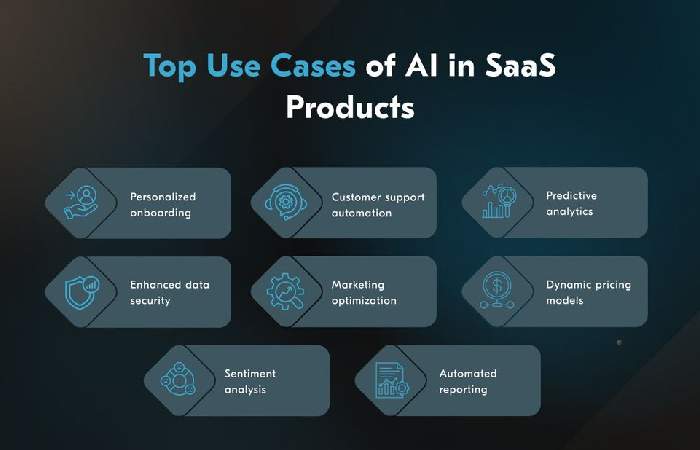
- Predictive Analytics and Insights Predictive analytics technology analyzes user patterns to support user engagement even before needs arise. For example, predictive analytics technology offers AI analysis to SaaS businesses to understand user engagement patterns, such as which features a customer will use more. Therefore, businesses can suggest tailored engagement solutions to users ahead of time.
- Adaptive User Interfaces User Interfaces which are driven by AI can be modified by individual user activities. For example, if a user regularly uses certain features, they will be prioritized in the interface. This enhances the user experience.
- Hyper-Personalized Recommendations AI has revolutionized recommendation engines. AI analyzes usage and offers feature and update suggestions. This is useful in SaaS offers in design or project management tools and CRM even.
Future of AI in SaaS Platforms (Global Outlook)
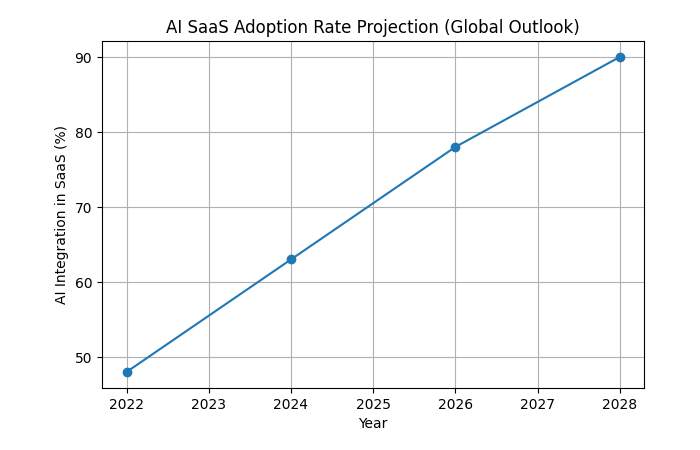
AI SaaS Adoption Rate Projection:
| Year | AI Integration in SaaS (%) |
| 2022 | 48% |
| 2024 | 63% |
| 2026 | 78% |
| 2028 | 90% |
SaaS Platform Pricing in Top 5 Countries
| Country | Avg Monthly Cost (USD Equivalent) | Popular SaaS Usage | Online Availability |
| USA | $50–$150 | CRM, AI analytics | Widely available |
| UK | $45–$130 | Marketing automation | High |
| India | $15–$60 | SMB cloud tools | Very high |
| Australia | $40–$120 | Project management | High |
| Canada | $45–$140 | Enterprise SaaS tools | High |
Most SaaS platforms operate via:
- Web browser access
- Mobile app (iOS/Android)
- Subscription-based software model
AI Avatar Generators: A Game-Changer
AI Avatar Generators An exceptional tool in the application of SaaS is the AI avatar generator. This tool lets companies design personalized digital avatars for employees or customers. For instance, AI generated avatars can walk users through onboarding, showcase features or assist the user. For example, these avatars can guide users through onboarding processes, demonstrate complex features, or provide virtual assistance.
By incorporating avatars into their platforms, SaaS businesses foster a sense of familiarity and engagement. These avatars often mimic human behavior and adapt based on user interaction, making them highly effective in delivering personalized support.
AI in Marketing and Customer Support
Marketing and customer service are two areas where SaaS platforms have experienced significant improvements thanks to AI:
1. Personalized Marketing Campaigns
AI allows SaaS companies to design marketing campaigns that resonate with specific user segments. By analyzing data such as user location, activity, and preferences, businesses can deliver personalized messages that are far more likely to convert.
2. Intelligent Customer Support
Chatbots and virtual assistants driven by AI now offer 24/7 assistance. These tools learn from user interactions to refine their responses over time. By offering instant solutions and reducing the need for human intervention, they enhance customer satisfaction.
Who Should Use SaaS Platforms and At What Stage
| User Type | Recommended Age | Why Use SaaS Platforms? |
| Startups | 20–40 | Low upfront cost, scalable |
| Small Businesses | 25–50 | Automation & CRM |
| Enterprises | 30+ | Data analytics & integration |
| Freelancers | 18–45 | Subscription-based tools |
| Educators | 25–60 | Collaboration & cloud tools |
SaaS platforms are ideal for:
- Remote teams
- Digital entrepreneurs
- Agencies
- E-commerce operators
- Corporate IT departments
Integrating AI in SaaS Platforms
AI’s integration into SaaS platforms doesn’t stop at avatars or recommendations. Video apps are another area where AI plays a pivotal role. Many platforms now leverage AI for real-time video editing, transcription, and analysis. For example, SaaS platforms offering collaborative video creation tools use AI to recommend edits or enhance visual quality based on user preferences.
Such applications of AI not only streamline workflows but also ensure that users feel their needs are uniquely addressed. By embedding AI into video tools, SaaS businesses provide more value and foster deeper engagement.
Challenges and Ethical Considerations
Despite its advantages, AI-driven personalization poses challenges. Privacy concerns are at the forefront as platforms must handle sensitive user data responsibly. Transparency in AI algorithms is also critical to ensure fairness and avoid bias in decision-making.
Businesses must adopt robust ethical guidelines to balance innovation with user trust. Building systems that prioritize security and offer opt-in personalization ensures that users remain in control of their data.
Compliance, Security & Data Regulations by Country
| Country | Regulation | Impact on SaaS |
| USA | CCPA | Data transparency |
| UK | UK GDPR | Privacy compliance |
| India | DPDP Act | Data localization |
| Australia | Privacy Act | Security enforcement |
| Canada | PIPEDA | Data protection |
Security is critical for cloud software solutions to maintain trust.
Future Trends in AI Personalization
Awaiting the Detection Systems, has Personalized AI Contextualization Systems, As AI technology advances, the separation of personalization of the service varies per customer.
Some of the new hot trends per customer include:
- When a customer submits a document or submits a voice memo, an AI will listen to or read to detect emotions to adjust the AI’s response to the customer.
- AI may also create a service that allows the customer to use AR.
- An AI will detect the environment of the AR user, allowing the user to customize the AR experience to match the user’s environment.
- An AI will also detect the user’s environment to provide an experience to the user.
- Customers will increase the experience of the service to the utmost satisfaction.
Conclusion
Subscription-based Software as a Service (SaaS) Platforms Personalized technology allows the user to use the technology to the fullest extent. Automation is based on time. Software solutions have monthly fees that increase or decrease based on the variances.
SAAS-defined Software as a Service has allowed for flexibility and rounded services = intelligent ecosystem. The intelligent Software as a Service (SaaS) responsive is the business of self automation. Predictive summary business insight hyper personalized will ensure optimal operation flow for all entities, from India Start Up to USA Enterprise. In time as predicted AI will be completed, Analytics AR Predictive will be the tool for Software as a Service for its continued customer satisfaction.
