

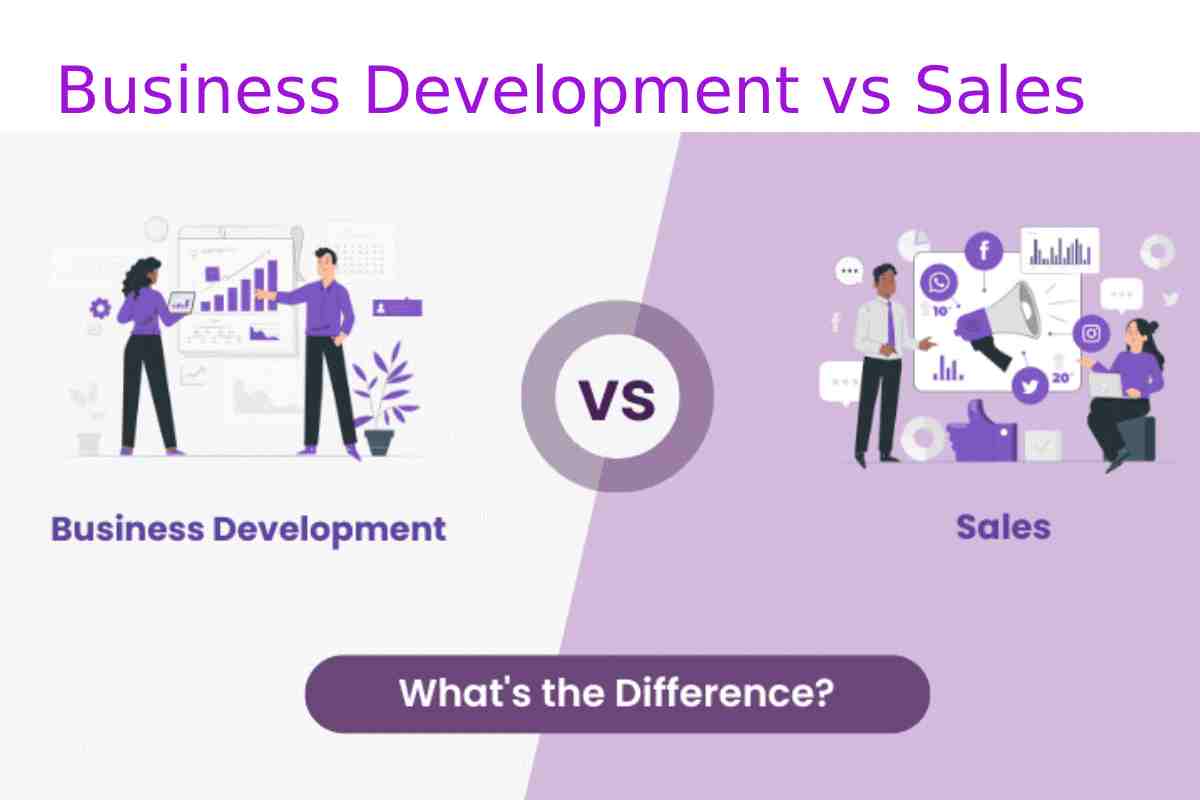
Business Development vs Sales is a comparison many businesses misunderstand. While both aim to grow revenue and bring customers in, they play different roles in the process.
Business development focuses on finding new opportunities, building relationships, and qualifying leads. Sales focuses on turning those qualified leads into paying customers.
When companies understand how business development and sales work together — especially within the sales funnel and lead generation strategy — they see stronger pipeline growth and better results.
Table of Contents
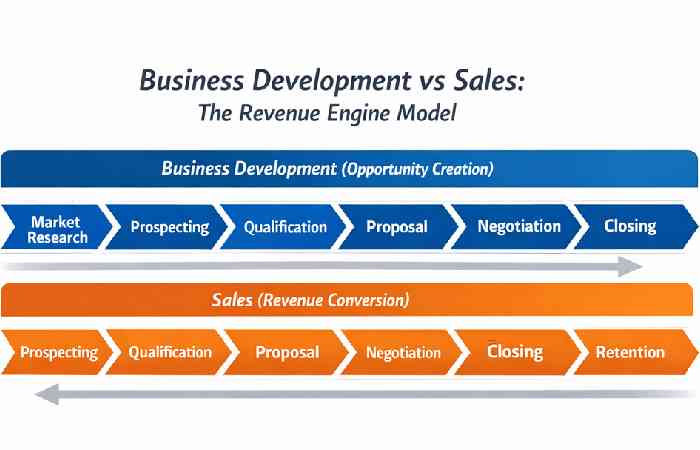
Visual Framework – Business Development vs Sales
What Is the Difference Between Business Development and Sales?
Many companies confuse business development vs sales, but they serve different roles within a revenue growth strategy.
Business development focuses on:
- Market expansion
- Strategic partnerships
- Lead generation
- Long-term opportunity creation
Sales focuses on:
- Closing deals
- Managing pipelines
- Negotiating contracts
- Converting qualified leads
High-Level Difference Between Business Development and Sales
| Area | Business Development | Sales |
| Primary Goal | Create opportunities | Close opportunities |
| Focus | Long-term growth | Short-term revenue |
| Stage | Top of funnel | Middle & bottom funnel |
| KPI | Qualified leads, partnerships | Revenue, conversions |
| Approach | Strategic & research-based | Tactical & execution-based |
Business Development
‘Business development’ typically refers to the sum of a company’s actions to classify prospects whose business needs match well with the benefits of its offering.
- The process often involves conducting prospect research, evaluating competitive positioning, networking, and forming strategic partnerships.
- In the setting of a sales process, the term “business development,” also known as “sales development,” usually mentions the first-level activities performed to identify.
- Here, connect, and ultimately qualify customers. Customers. Potential with an exceptionally high buying potential.
- Well-executed business development can set a flat course for sales reps, who function more throughout the sales process.
- As a result, generate friendlier prospects and, in turn, more direct and compelling value propositions.
Core Responsibilities Comparison
Business Development vs Sales Responsibilities
| Function | Business Development | Sales |
| Market Research | ✔ | Limited |
| Lead Qualification | ✔ | Partial |
| Cold Outreach | ✔ | Sometimes |
| Product Demo | Rare | ✔ |
| Contract Negotiation | No | ✔ |
| Strategic Alliances | ✔ | No |
| Account Management | Limited | ✔ |
This structured difference helps clarify the sales funnel vs business development confusion.
Sales Development Roles
- Sales development roles can include Business Development Representative (BDR) or Sales Development Representative (SDR) roles.
- These are characteristically entry-level roles within a company’s sales group that align with career trails in sales, account management, or customer success management.
BDR vs SDR vs Sales Representative
Understanding BDR vs SDR roles is key for scaling revenue teams.
Role Breakdown
| Role | Focus Area | Typical KPIs |
| BDR (Business Development Rep) | New markets & outbound prospecting | Meetings booked, pipeline value |
| SDR (Sales Development Rep) | Inbound lead qualification | SQLs (Sales Qualified Leads) |
| Sales Representative | Closing deals | Revenue closed, win rate |
These roles form a layered structure within a go-to-market strategy.
The Business Development Vs Sales
The distinction amid business development and sales essentially boils down to the difference between “line up” and “lose weight.” Business development representatives identify and deliver appropriate leads so a company’s sales team can reach more accessible and responsive prospects.
While sales and business development need separate teams and represent diverse roles. It’s easy to see the rank of both strategies working in unison.
A sample sale is impossible without dedicated business development:
- The relationship-building required for business development depends on a solid solution and a reputation for effectively adapting to a particular market.
- SDR and sales rep positions don’t overlap too much in day-to-day operations unless their representatives are responsible for some of their prospecting.
- With this in mind, both teams need to be aligning to get the most. Out of your broader sales efforts.
- SDRs, BDRs, and salespeople need to understand your company’s ideal buyer persona and constantly identify suitable opportunities.
Business Development vs Sales Funnel Alignment
Funnel Mapping
| Funnel Stage | Responsible Team |
| Awareness | Business Development |
| Lead Generation | Business Development |
| Lead Qualification | SDR |
| Proposal | Sales |
| Negotiation | Sales |
| Closing | Sales |
| Expansion | Sales + Account Team |
When aligned properly:
- Lead quality improves
- Sales cycle shortens
- Customer acquisition cost decreases
Revenue Impact and Performance Metrics
Key Metrics Comparison
| Metric | Business Development | Sales |
| Lead Volume | ✔ | No |
| Lead Quality | ✔ | Partial |
| Pipeline Growth | ✔ | ✔ |
| Close Rate | No | ✔ |
| Revenue Target | No | ✔ |
| Customer Retention | Limited | ✔ |
Revenue Contribution Timeline
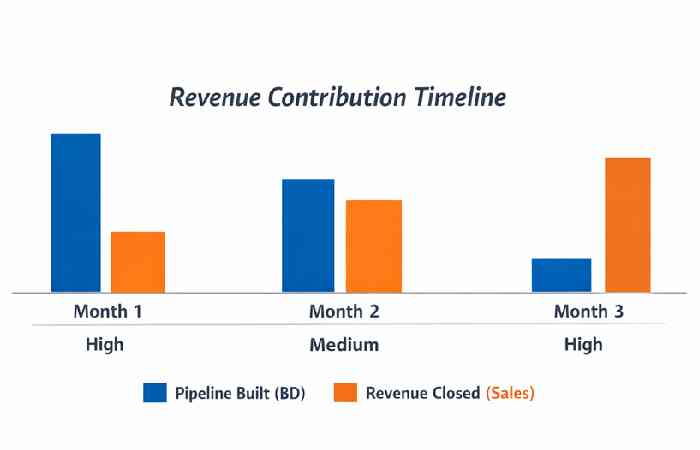
| Month | Pipeline Built (BD) | Revenue Closed (Sales) |
| Month 1 | High | Low |
| Month 2 | Medium | Medium |
| Month 3 | Low | High |
This visually explains how business development feeds sales revenue over time.
Revenue Growth Strategy – How Both Work Together
Business development and sales are not competitors. They are interdependent functions within a broader revenue growth strategy.
Key alignment factors:
- Shared ideal customer profile (ICP)
- Clear handoff process
- CRM transparency
- Regular feedback loops
Companies that separate these roles clearly tend to experience:
- Higher close rates
- Better pipeline predictability
- Stronger long-term growth
Conclusion
The biggest mistake companies make when comparing business development vs sales is expecting both teams to close deals. Business development builds the runway. Sales makes the landing. Without both, sustainable revenue becomes unpredictable.
Authoritative Resources
For further reading:
Harvard Business Review – Sales Strategy & Growth
https://hbr.org
McKinsey & Company – Revenue Growth & Go-to-Market Strategy
https://www.mckinsey.com
These resources provide global insights into business development and sales alignment.
