

Facebook Libra, later renamed Diem, was a blockchain-based digital currency project announced by Meta (formerly Facebook) in 2019. Its goal was to create a global digital payment system designed to provide low-cost financial services, particularly for unbanked populations worldwide.
Unlike decentralized cryptocurrencies such as Bitcoin or Ethereum, Diem was built as a permissioned blockchain network, governed by an independent association.
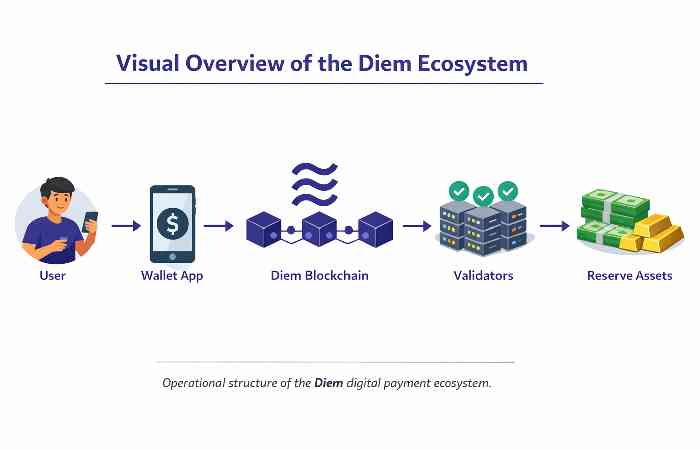
Operational structure of the diem digital payment ecosystem.
Table of Contents
Timeline of Facebook Libra to Diem (2019–2026)
Facebook Libra → Diem Milestones Through 2026
| Year | Event | Notes |
| 2019 | Facebook Announces Libra | Revealed as a global digital currency project aimed at financial inclusion. |
| 2020 (Q1) | Libra Whitepaper Published | Outlined technical & governance structure of the network and multi-stablecoin design. |
| 2020 (Q2-Q3) | Global Regulatory Pushback Begins | US lawmakers and EU regulators raised concerns about financial stability, privacy, and monetary control. |
| 2020 (Dec) | Libra Rebrands to Diem | Name change intended to reflect a new direction and differentiate from early criticism. |
| 2021 (Mid) | Restructuring of Project Leadership | Some founding members leave; Diem Association reshuffles strategy. |
| 2021 (Late) | Association Seeks Regulatory Approval | Diem Association pursues charter/approval in select jurisdictions. |
| 2022 (Jan) | Diem Assets Sold to Silvergate Capital | News breaks that Diem Association sells technology & assets, effectively winding down original project. |
| 2022 (Mid) | Project Activity Becomes Dormant | Development slows significantly; few public deliverables emerge. |
| 2023 | Industry Shifts to CBDCs & Stablecoins | Governments & private stablecoins (USDC, USDT) gain focus; Diem project legacy cited in research. |
| 2024 | Academic & Policy Analysis Increases | Diem referenced in studies on regulation, digital finance, and stablecoin risks. |
| 2025 | Lessons from Diem Influence Global Initiatives | CBDC pilots in Asia/Europe reference governance models similar to those discussed in Diem whitepaper. |
| 2026 (Projected) | Legacy Tech Gets Integrated Into New Platforms | Elements of permissioned blockchain thought leadership and multi-asset stablecoin concepts influence enterprise payment research. |
Resource:
Reuters Coverage: https://www.reuters.com/technology/meta-backed-diem-assets-sold-2022-01-31/
Original Whitepaper Archive: https://www.diem.com/en-us/white-paper/
Is Diem a Cryptocurrency?
- Fine, Libra is based on blockchain and uses crypto technology.
- But, the term cryptocurrency generally implies specific properties Libra does not have.
- However, if you want to read about these properties in more detail, we have discussed them in our detailed cryptocurrency tutorial.
- In short, as far as Libra is anxious, it would be more accurate to call it a digital currency.
Governance Structure of the Diem Association
The project was governed by the Diem Association, based in Switzerland.
Governance Model Overview
| Governance Element | Description |
| Location | Geneva, Switzerland |
| Members | Tech, fintech, VC firms |
| Validator Nodes | Run by association members |
| Decision Making | Board-based governance |
| Target Members | 100 planned at launch |
How Will Diem Work?
The Libra Blockchain (renamed Diem Blockchain) is a lawful blockchain that forms this payment system’s backbone. So how is it dissimilar from other blockchains?
- We frequently talk about how blockchains like Bitcoin or Ethereum are permissionless.
- However, it means that anyone with an internet connection can freely access them, transact with them, or build on them.
- Here is no one (or anything) regulatory access. But, this is not the situation for a licensed blockchain.
- Here to use it, you will need the permission of whoever owns the network.
- Or, extra specifically, the applications you use will require special access.
- Libra is a permissioned blockchain also income that it won’t use mining or staking to validate transactions like many other blockchains.
- In its place, it will rely on a set of authorized validators (members of the Libra Association) to validate the transactions.
- Giving its creators, Libra can transition to a proof-of-stake (PoS) system after the first five years.
- But, this is a long time in such a fledgling space.
However, they explain their choice in the Libra white paper. There is currently no permissionless system supporting billions of people transacting on it from his perspective.
Technical Architecture of the Diem Blockchain
Diem used a permissioned blockchain, meaning only approved validators could process transactions.
Technical Features
| Feature | Diem Blockchain | Bitcoin |
| Access | Permissioned | Permissionless |
| Validators | Approved members | Anyone |
| Mining | No | Yes |
| Energy Use | Lower | High |
| Governance | Association | Community consensus |
Permissioned vs Permissionless Blockchains
| Characteristic | Permissioned | Permissionless |
| Control | Restricted | Open |
| Speed | Higher throughput | Slower |
| Censorship Resistance | Lower | Higher |
| Regulation Friendly | Yes | Limited |
| Examples | Diem | Bitcoin, Ethereum |
Is Diem Decentralized or Centralized?
- According to many in the blockchain space, authorized blockchains cannot be.
- They are decentralizing as their permissionless counterparts and are more like a traditional corporate database.
- Here Libra is not resistant to censorship like Bitcoin and other cryptocurrencies in this sense.
- Meanwhile, these validators must be members of the Libra Association, and the network could be relatively centralizing.
- Happening the other hand, regulatory and examining which applications can interact with the distributed ledger can be advantageous.
- E.g., it may be easier to exclude malicious apps and scams.
Centralization Debate in Digital Currencies
- Critics argued Diem lacked decentralization
- Validators were pre-approved
- Governance structure resembled a corporate consortium
- Supporters argued regulation required structure
- Designed to comply with global financial laws
The Libra Payment System
The Libra payment system (renamed payment system Diem) supports multiple stable currencies to a single currency linked to fiat currencies such as USD, EUR, GBP.
- You may already know this effort is similar to stablecoins, as their value is deriving from the Libra Reserve reserve.
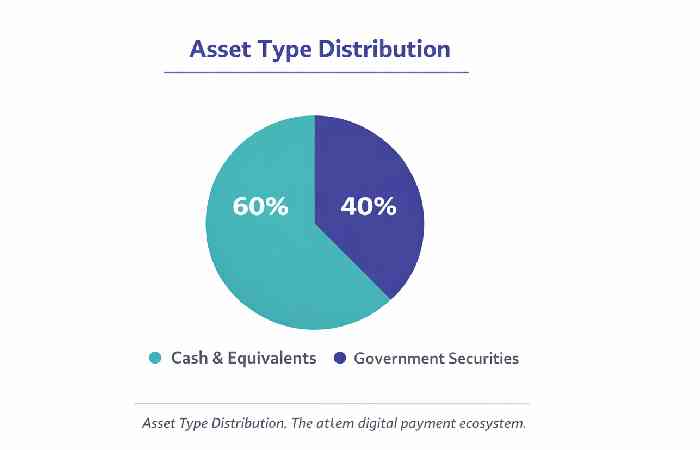
- This reserve comprises cash, cash equivalents, and short-term government securities.
- Here the Libra payment system will also support a multi-currency currency called Diem Dollar (formerly LBR).
- It combines all these other stable coins and is backing by a basket of assets that ensure its value.
- However, you could think of it as a stablecoin of stablecoins (and possibly other assets, like securities).
- However, the idea is that these various forms of collateral could protect you from volatility.
- Here is an essential aspect of something that purports to act as payment.
Stablecoin Structure and Reserve Model
Diem was structured as a stablecoin-backed digital asset.
Reserve Composition Model
| Reserve Component | Purpose |
| Cash | Liquidity |
| Short-term government bonds | Stability |
| Cash equivalents | Risk management |
Global Regulatory Response
Diem faced scrutiny from regulators worldwide.
Regulatory Reactions
| Region | Concern |
| United States | Monetary policy impact |
| European Union | Financial stability |
| India | Capital control |
| UK | Consumer protection |
| Switzerland | Oversight & compliance |
Why Facebook Libra (Diem) Matters in Blockchain History
Strategic Impact on the Industry
| Area | Impact |
| Stablecoin Regulation | Accelerated oversight |
| CBDC Development | Governments accelerated research |
| Tech-Finance Partnerships | Increased scrutiny |
| Blockchain Legitimacy | Elevated global debate |
Conclusion
Facebook Libra (Diem) will go down as one of the most ambitious projects for a corporate backed digital currency. While it did not launch at scale, it did shape the discourse around the world on stablecoins, central bank digital currencies, and the governance of blockchain. It illustrated the difficulties of combining Big Tech and the monetary system and the need for regulation, decentralization, and trust in digital finance.
